


Drawdown in Forex is a fundamental metric that traders use to gage the amount of lost capital incurred from losing trades.
Knowledgeable traders use this information in order to calculate how likely their trading systems are to survive over the short and long run. Therefore a comprehensive understanding of drawdowns is a key component to knowing how viable your trading setup is and can be.
What is Drawdown in Forex Trading?
Drawdown is a measurement of portfolio performance and how much it can absorb a loss before the loss starts to cut into profits.
A drawdown is related to a single position where you enter the position and the price may go against you and put you in a relative loss before going up once again.
It is also used to measure the health of an entire portfolio where you take the winners and the losers together to determine what was the highest sequence of accumulating losses in the portfolio.
The Two Types of Drawdown
Absolute Drawdown
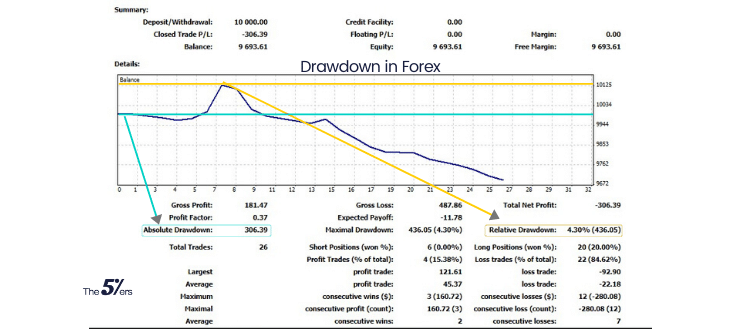
The absolute drawdown is the numerical difference between the first deposit and the slightest point under the deposit level for the duration of the test. Simply put, this number tells you how big your loss can be while trading in relation to the first deposit you made.
This metric is usually used by Investors that are not actually measuring performance, but rather those that are only concerned with bringing returns.
Relative Drawdown
The second type of drawdown in forex is relevant for traders who are always considering his or her performance efficiency. The relative drawdown is an indicator of how much these traders can risk as opposed to the initial investment amount. This is because the relative drawdown is the maximum drop of Equity in percentage, not an absolute amount.
There are two ways to measures relative drawdown:
1.Balance to equity:
The difference from the highest account Realized Balance to the following lowest Equity (unrealized Value).
Example: if you begin with a $10K evaluation account, the max. drawdown is $400 which means, the lowest Equity value is $9600.
if you earn $200 after a while, the account balance will be $10,200. Now, the lowest Equity value becomes $9800. (The drawdown functions like a trailing stop loss).
2.Equity to Equity:
This way of measuring is more strict from the other one, it measured the difference from the highest account unrealized Value to the following lowest unrealized Value (Equity ).
Example: if you begin with a $10K evaluation account, the max. drawdown is $400 which means, the lowest Equity value is $9600.
if you have a floating position with a $200 profit after a while, the account equity will be $10,200. Now, the lowest Equity value becomes $9800. (The drawdown functions like a trailing stop loss from equity to equity).
How to Keep Drawdown in Forex Under Control
Five ways to keep drawdown in forex under control:
- low risk – In fact, let’s make this a rule. Keep your risk below 1% of your total account. If you lose, you need to lose small.
- take a break – If you find your account heading south with no end in sight, it’s extremely important that you do whatever you can to immediately begin to reduce risk. Pour over your trading strategy and plan and find any place where risk prevention can be tightened.
- rethinking – If you can’t limit risk and the losses just won’t stop, walk away. You can always pull the plug and the damage will be less than if you tried to weather the storm and your account got completely obliterated.
- Continuity and consistency – there is a building improvement, risk settle, and decreases, and your account starts to head in a positive direction.
- leverage – Adjust the leverage according to the max drawdown you allowed for in your trading plan. This one is pretty self-explanatory. We’ve outlined the pros and cons of leverage in forex trading and if you can properly use it and control it, it can help you grow your account and succeed as a trader.


